What Can You Actually Plan Before You Know Your Students?
Before the first day, you can know the curriculum, the calendar, the length of the period, and perhaps the names on your class list.
You cannot yet know whether a task will take this class eight minutes or twenty-five. You do not know who will happily think aloud, who needs time before speaking, which vocabulary will get in the way, or how much independence a new routine can carry.
The temptation is to answer that uncertainty with more planning: another slide, another activity, every transition timed, the whole first week filled to the edges.
But some planning decisions become better only after students are in the room. A useful first-week plan is therefore unfinished in specific places. Before students arrive, decide the learning that matters, prepare a task that will show you something, make the first routine clear, and sketch more than one possible next move. Leave the exact pace, grouping, scaffolds, and volume of work open until the class gives you evidence.
That is not underplanning. It is refusing to pretend you already know what only your students can tell you.
Decide what should not depend on the class
Some parts of the plan should be clear before anyone walks through the door.
Name the learning that matters
Write the curriculum intention in language that will help you make decisions during the lesson.
“Fractions” is too broad. “Students compare fractions” is better. “Students can compare two fractions and justify the comparison with a model or number line” is useful enough to plan from.
This gives you something stable when the activity changes. If the technology fails, the discussion runs long, or students need another example, you can alter the route without losing the reason for the lesson.
Choose a first task that reveals thinking
The first task should be real subject work, not a disguised survey. It should have an accessible starting point, allow more than a one-word response, and leave behind something you can examine: a model, explanation, attempt, question, or decision.
You are not trying to measure everything students know. You are choosing useful work that also helps you notice where to go next.
For example:
- Instead of asking students whether they feel confident with fractions, ask them to compare two fractions and show why.
- Instead of asking whether they enjoy reading, give them a short, worthwhile passage and ask what they notice, wonder, and infer.
- Instead of reviewing every lab rule on slides, let students examine a simple setup, identify possible problems, and explain how they would make it safer.
The work gives you better planning information than a prediction made without the class.
Make the first routine genuinely clear
You do need a plan for how students enter the work: what they need, where the instructions live, what to do when they are stuck, and how the class will come back together.
Keep that first routine modest. A complicated rotation, unfamiliar app, new discussion structure, and challenging task introduced at the same time make it hard to tell what caused difficulty. When the routine is simple, you can see more of the learning.
Prepare two useful directions, not one perfect sequence
For the first substantial task, prepare a credible next move in either direction:
- If students are ready, how can the thinking become deeper rather than merely longer?
- If they are not ready yet, what example, representation, smaller step, or additional practice would help?
These are not separate lesson plans. They might be one extension question and one model you can bring forward if needed. The point is to avoid forcing every class through the same next step simply because it is already on the slides.
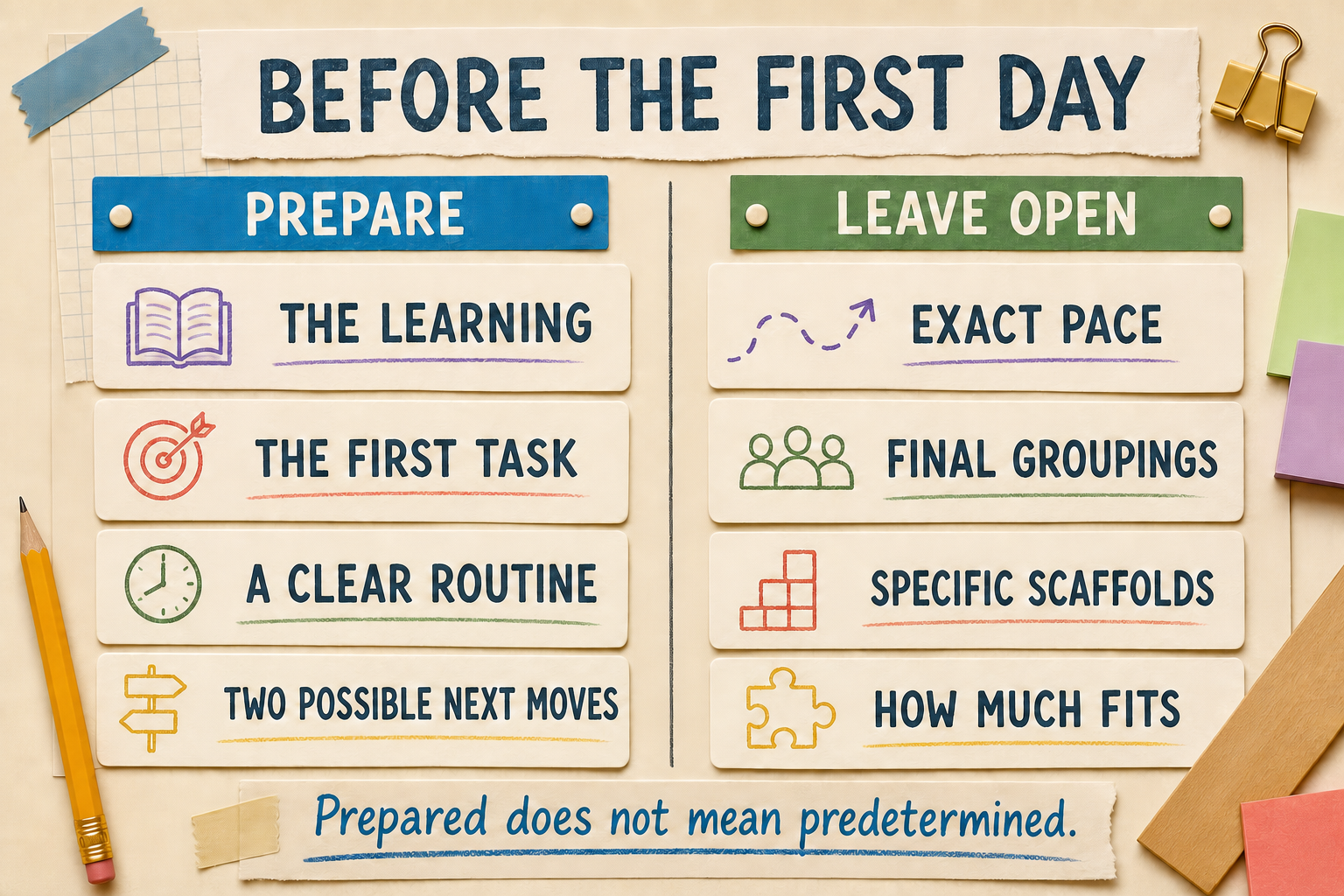
Prepare a strong beginning. Leave the decisions that depend on students open.
Leave these decisions open
Several choices look like preparation but are really conclusions about students you have not met.
Exact pacing
Give the lesson shape, but do not treat every minute as a promise. Mark the point the class must reach and the part that can move to another day. A schedule with no breathing room assumes no questions, transitions, interruptions, or unexpected thinking.
Fixed groups
Unless you have reliable information that requires a particular arrangement, start with temporary, easy-to-change groupings. Watch who begins quickly, who makes space for others, who disappears in a group, and which combinations help students think. Use that information before making grouping carry more weight.
Specific scaffolds for imagined barriers
Prepare access, not assumptions. Make directions readable, materials usable, and more than one representation available. But wait before deciding that a particular student needs simplified thinking, a permanent sentence frame, or different work.
First identify the barrier. A student may understand the concept but be decoding the instructions, unfamiliar with the routine, processing new vocabulary, or deciding whether it is safe to take a risk in front of a new class.
A fully detailed week
Outline the week. Fully prepare the first meaningful encounter and the materials you are likely to need next. But be careful about polishing Friday before Monday has shown you whether Tuesday still makes sense.
The farther a decision sits from evidence, the cheaper it should be to change.
A worked example: Grade 6 fractions
Suppose the curriculum goal is for students to compare and order fractions and justify their reasoning using representations.
Before meeting the class, the teacher prepares this opening task:
Which is greater: 3/4 or 5/8? Show your thinking in a way that could convince someone who disagrees.
Students can enter through a drawing, fraction strips, a number line, equivalent fractions, or an explanation. The comparison is not the whole unit; it is a useful first window into it.
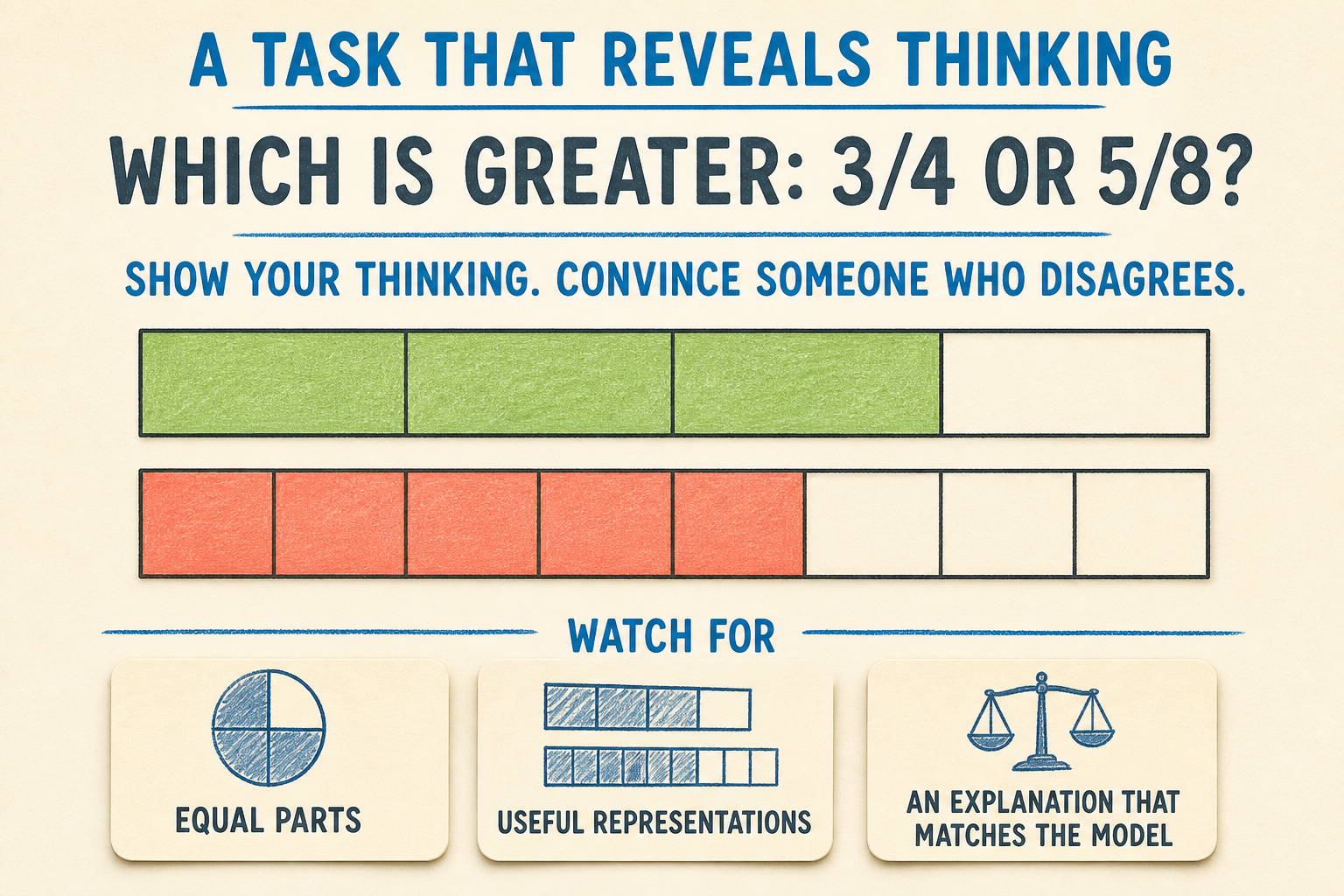
The prompt advances the mathematics and gives the teacher several kinds of thinking to notice.
The teacher prepares blank fraction strips and number lines for anyone who wants them, plus one extension: Find a fraction that belongs between 5/8 and 3/4. How do you know?
During the task, the teacher watches for a few specific things:
- Are the wholes the same size when students draw models?
- Do students partition the whole into equal parts?
- Can they connect the picture, number line, or equivalent fraction to the symbols?
- Can they explain why their representation proves the comparison?
- Is any difficulty coming from the mathematics, the wording, or the expectation to explain?
Those observations determine the next lesson.
If many students draw unequal parts, the class may need a short, concrete return to what the denominator describes. If models are accurate but the symbolic comparison is shaky, the next lesson can connect the representations to equivalent fractions. If students compare successfully, the teacher can move into ordering several fractions and examining efficient strategies. If the mathematics is visible but explanations are thin, students can compare two sample justifications and improve one.
None of those responses requires rebuilding the unit. They require the teacher to have left room for the answer.
The same principle transfers to other subjects. A short source analysis can reveal how students use evidence in history. An unfamiliar but approachable text can reveal reading and discussion habits. A design challenge can reveal how students test, revise, and explain. The first task should advance the subject and help you see the class more clearly.
Copy this planning page
You can use these prompts for the first substantial lesson in a course, unit, or term:
| Before students arrive | Your notes |
|---|---|
| The learning that stays: What should students understand or be able to do? | |
| The first task: What worthwhile work will also reveal their thinking? | |
| What I will watch for: Which two or three details would change my next decision? | |
| If they are ready: What adds depth, complexity, or independence? | |
| If they are not ready yet: What example, representation, or smaller step could help? | |
| What can wait: Which decisions should I make only after seeing the class? |
When those answers are usable, stop planning. You do not need to eliminate uncertainty before the first day. You need a lesson strong enough to begin and flexible enough to learn from.
Make four notes after the lesson
Before the day disappears, capture four short observations:
- Students can already…
- Their thinking became uncertain when…
- The task or routine got in the way when…
- Tomorrow I will…
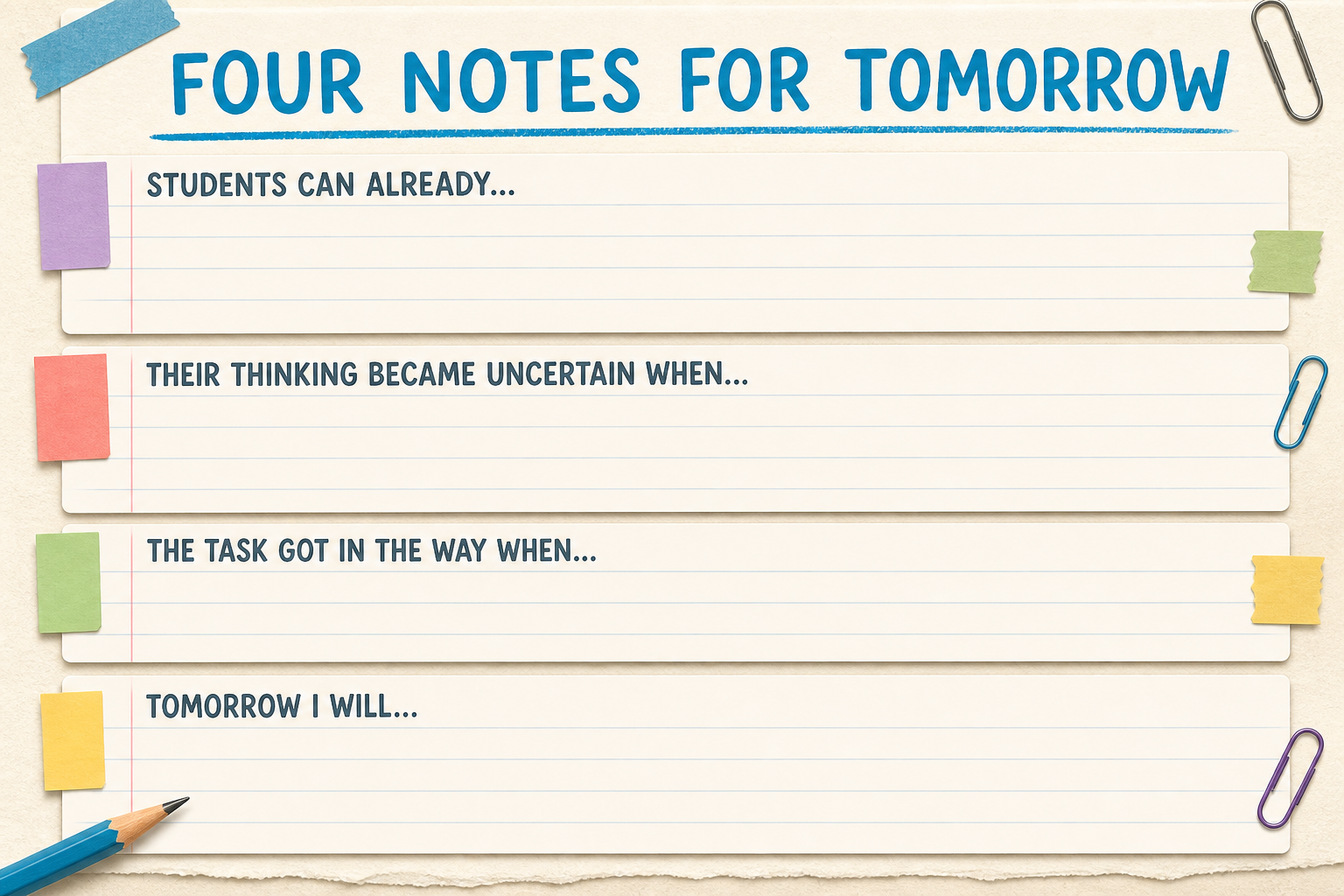
Four descriptive notes are enough to make tomorrow’s plan more responsive.
Keep the notes descriptive. “They are weak at explaining” closes down possibilities. “Six responses gave an answer without pointing to evidence in the model” gives you something to teach.
There will always be more you could prepare before meeting a class. The better question is whether preparing it now will improve the lesson—or simply make a future decision harder to change.
Plan the learning. Prepare a revealing first task. Make the opening routine clear. Then leave enough space for your students to affect what happens next.