The group made it. What did each student understand?
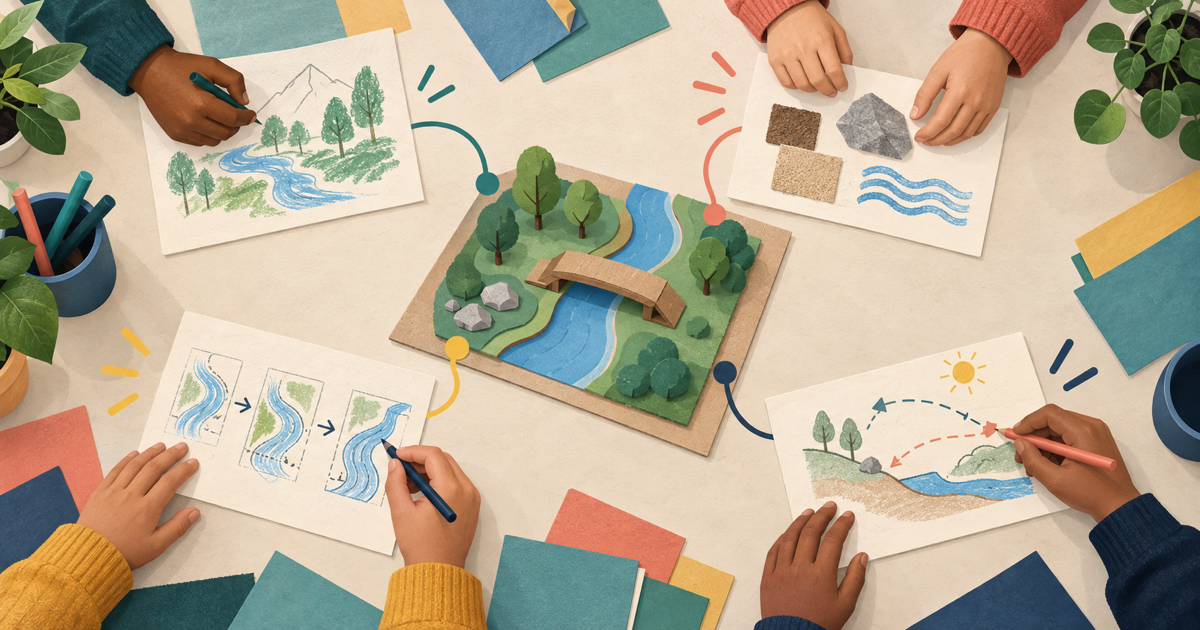
The model works. The presentation is polished. The lab conclusion sounds convincing. The group has produced something worth sharing.
But you still cannot tell what each student understands.
That is not a reason to abandon group work or divide every task into four isolated jobs. It is a design problem: the task produced strong evidence of what the group could make together, but weak evidence of what each student could explain, transfer, or defend.
Use a shared task with individual evidence windows. Students keep the intellectual benefits of collaboration while each person leaves a small, meaningful trace of their own thinking.
Collaboration needs structure, not surveillance
The Education Endowment Foundation's collaborative learning evidence review finds positive effects on average but low overall evidence security and substantial variation. Its practical message is more useful than the headline number: effective collaboration is structured, commonly uses groups of three to five with a shared outcome, and needs tasks that make participation and talk possible for everyone.
The goal is not to catch a student who contributed less to a poster. Contribution and understanding are related, but they are not the same thing. A student may organize materials expertly without understanding the concept. Another may understand deeply but have limited access to fast-moving group talk.
Collect evidence of the learning target, not a vague impression of busyness.
Step 1: name the shared product and the individual claim
Before students begin, complete both lines:
- Together, the group will produce:
- Individually, every student will be able to:
For example:
- Together, the group will build a model of water moving through a watershed.
- Individually, every student will explain one cause-and-effect relationship in the model and predict what changes when one feature is altered.
Or:
- Together, the group will recommend a response to a fictional community problem using three sources.
- Individually, every student will defend one source choice, identify a limitation, and explain how it affected the recommendation.
The individual claim should use the same intellectual demand as the shared task. If the group analyses but individuals only define vocabulary, the evidence window misses the learning you care about.
Step 2: design one shared task that requires exchange
A collection of separate jobs is not automatically collaboration. If one student researches, one writes, one decorates, and one presents, each student can complete a role without encountering the group's full reasoning.
Choose a product that requires students to compare, select, connect, test, or revise ideas together.
Useful shared moves include:
- choosing between two plausible models;
- ranking evidence against agreed criteria;
- building one explanation from several partial accounts;
- testing a design against multiple constraints;
- revising a claim after another student introduces conflicting evidence.
Roles can support access and organization, but they should not become intellectual silos. Rotate the thinking moves or require the group to pause where everyone must interpret the same key evidence.
Step 3: place three individual evidence windows
An evidence window is a short moment when each student responds independently. It should be small enough to preserve the collaborative task and precise enough to reveal the target.
Window A: before the group decides
Ask every student to commit to an initial idea.
Which option currently seems strongest? Record one reason or representation.
This gives quieter students an entry point and lets you see how thinking changes through collaboration. It is not a vote the group must follow.
Window B: while the group is working
Pause at the task's most important decision.
Choose one prompt:
- Explain the connection your group is using right now.
- Sketch the part of the model that carries the main idea.
- Name the evidence that most changed the group's direction.
- What is one disagreement the group has not resolved?
Students may write, draw, record audio, use an augmentative communication system, or explain briefly to you. Keep the response mode flexible while holding the intellectual demand steady.
Window C: after the shared product
Use a transfer, defence, or repair prompt—not a request to describe what the group did.
One condition has changed. What should the group revise, and why?
Which claim in the product is best supported? Name the evidence and one limitation.
Here is a plausible error another group could make. Locate and repair it.
If students can only repeat the final wording, the product may have hidden the learning. A small variation helps show whether the idea belongs to the student, not only to the poster.
A worked example: the shared ecosystem model
Imagine a group of four building a food-web model and explaining how a reduction in one population could affect others.
Shared outcome
The group creates one model with arrows and a written causal chain. They must agree on the direction of each relationship and identify uncertainty where evidence is incomplete.
Individual claim
Each student explains a two-step effect, uses the model as evidence, and predicts what might happen when a different population changes.
Evidence windows
- Before: each student sketches one likely two-step effect.
- During: each student annotates one arrow with what it means and how the group knows.
- After: each student receives a different changed condition and revises one part of the model.
The teacher does not need four separate projects. The shared model remains central; the windows reveal whether each student can use it.
Sort the evidence without turning it into four grades
After the task, sort individual responses by the next instructional need.
| Evidence pattern | Possible response |
|---|---|
| Explains and transfers the central idea | Offer a more complex condition or ask the student to compare models |
| Uses the shared product but cannot yet explain the connection | Rehearse the reasoning with one worked example, then try a new case |
| Repeats group language without evidence | Ask the student to point to, draw, or select the evidence behind one claim |
| Shows a coherent alternative or misconception | Use a contrasting case and invite revision |
| Provides no usable evidence | Change the response mode or check the barrier privately; collect evidence again |
Do not average the group product and the individual window into a mathematically neat number unless that method fits your local assessment policy and purpose. The two sources answer different questions. The group product shows collaborative performance; the individual window shows what one student can currently do with the idea.
Keep access from becoming invisibility
Some students need more processing time, a preview of the discussion question, visual supports, a scribe, speech-to-text, or another response mode. Build those supports into the evidence window.
Do not make spontaneous public speaking the default proof of understanding unless oral performance is itself the target. Fast talk is easy to notice, but it is not a neutral measure of thought.
Likewise, do not assume the student who designed the slides understood less, or the student who delivered the presentation understood more. Ask each student to do the same core thinking in an accessible form.
A planning block for the next group task
- Learning target:
- Shared product:
- The decision that requires collaboration:
- What every student should understand or be able to do:
- Window A — initial thinking:
- Window B — key decision:
- Window C — transfer, defence, or repair:
- Accessible response options:
- What I will do with each evidence pattern:
If the group can divide the task without exchanging ideas, strengthen the shared decision. If the individual window measures a lower-level skill than the group task, strengthen the prompt. If the window takes longer than the collaboration, shrink it.
The aim is not to make every student's contribution identical. It is to make every student's learning visible enough for the next teaching decision.
Let the group build something none of its members would have built alone. Then give each learner one honest opportunity to show what they can now see, explain, and do.